
Start with the client outcome you want to deliver
The cleanest way to choose is to work backwards from the experience your clients should feel during and after the transition: clarity, confidence, responsiveness, and predictable execution. Then design the business and operating structure that supports that experience.
Your client avatar drives the decision
High-complexity households (trusts/entities, ongoing money movement, distribution timing) tend to require more operational structure. More straightforward households may prioritize speed-to-market and simple workflows.
Your operating appetite matters
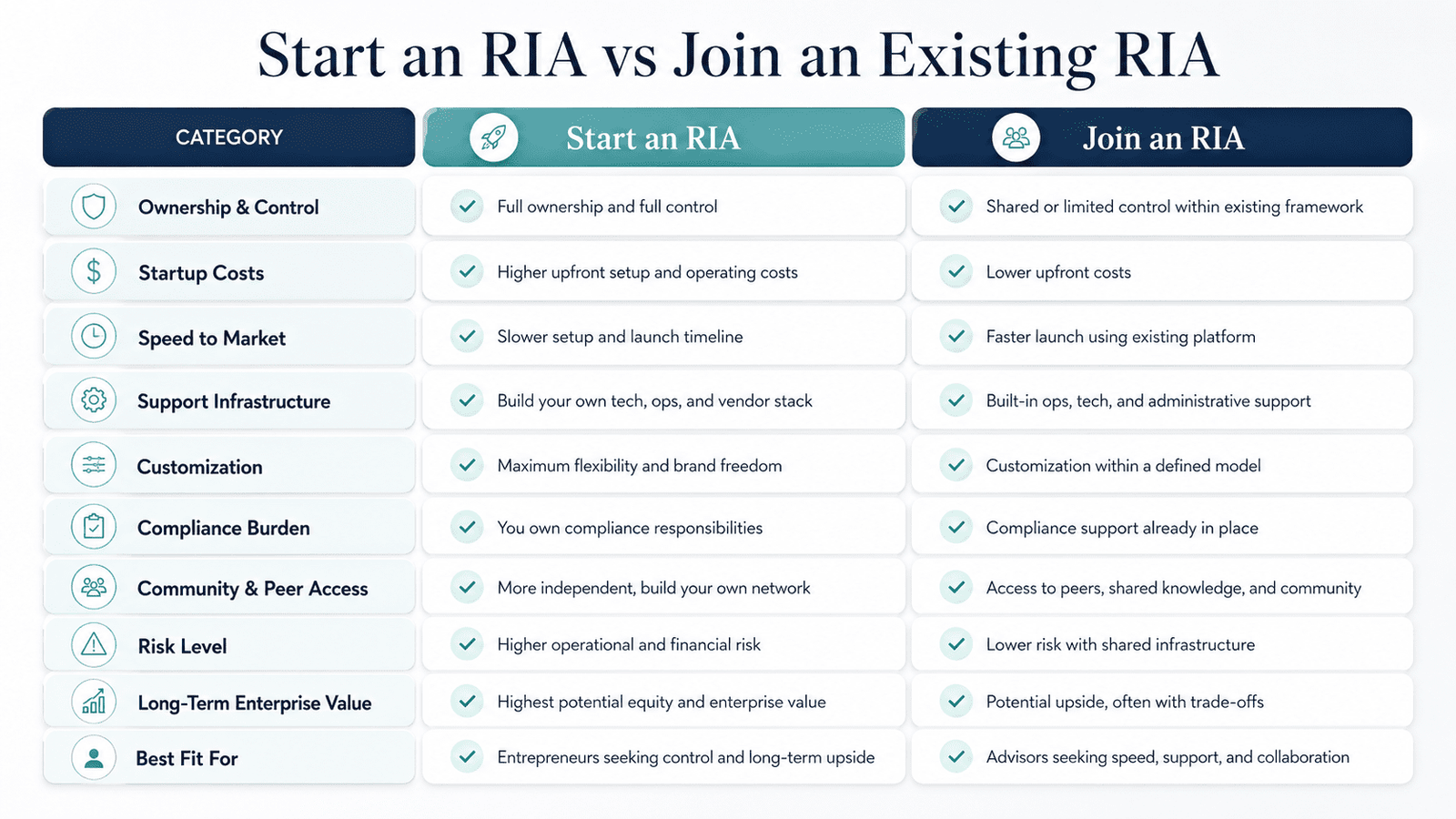
Starting an RIA can offer maximum control, but it also means building more from scratch. Joining an existing RIA can accelerate the build by using established infrastructure—at the cost of some autonomy.
Quick comparison (visual)
What “fit” actually means in real life
The best choice is rarely “obvious” because both paths can work well. Instead of trying to predict perfection, focus on how each path handles the things that matter operationally: onboarding support, compliance workflows, technology adoption, and how exceptions are handled when a client situation is not standard.
Decision questions that prevent regret
- Control vs support: How much control do you need, and how much structure do you want built for you?
- Timeline: How fast do you need to be fully operational (not just “announced”)?
- Compliance operations: What will be owned in-house vs supported or outsourced?
- Technology + workflows: How will accounts be opened, transfers tracked, and exceptions resolved?
- Client communications: Who owns the cadence and expectations during the transition?
- Completion tail: How will you handle stragglers, residuals, and post-move cleanup (like cost basis or special account needs) if they arise?
Where Continuity fits
Continuity supports the operational lane of advisor transitions—so the move is executed with clear standards, tracking, and a completion plan. Whether you start an RIA or join an existing one, the transition still has to run: data preparation, paperwork, transfer tracking, exception management, and “stay until it’s done” completion for stragglers.
Next step: Transition Readiness Call
Readiness helps you pressure-test your plan before you commit: timeline reality, account complexity, operational risk points, and the workstreams you’ll need. If you’re deciding between starting an RIA or joining one, readiness also helps you map which structure best supports the client experience you’re trying to deliver.
Prefer to talk now? Call (480) 631-0700.
High-trust references
For authoritative, official reference material (definitions, public tools, and investor-facing education), these are reliable starting points: